I have been thinking for a while about writing on visualization of geophysical data. I finally got to it, and I am now pleased to show you a technique I use often. This tutorial has shaped up into 2 independent posts: in the first post I will show how to implement the technique with Surfer, in the second one with Matlab (you will need access to a license of Surfer 8.08 or later, and Matlab 2007a or later to replicate the work done in the tutorial).
I will illustrate the technique using gravity data since it is the data I developed it for. In an upcoming series of gravity exploration tutorials I will discuss in depth the acquisition, processing, enhancement, and interpretation of gravity data (see [1] and [4]). For now, suffice it to say that gravity prospecting is useful in areas where rocks with different density are laterally in contact, either stratigraphic or tectonic, producing a measurable local variation of the gravitational field. This was the case for the study area (in the Monti Romani of Southern Tuscany) from my thesis in Geology at the University of Rome [2].
In this part of the Apennine belt, a Paleozoic metamorphic basement (density ~2.7 g/cm3) is overlain by a thick sequence of clastic near-shore units of the Triassic-Oligocene Tuscany Nappe (density ~2.3 g/cm3). The Tuscan Nappe is in turn covered by the Cretaceous-Eocene flish units of the Liguride Complex (density ~2.1 g/cm3).
During the deformation of the Apennines, NE verging compressive thrusts caused doubling of the basement. The tectonic setting was later complicated by tensional block faulting with formation of horst-graben structures generally extend along NW-SE and N-S trends which were further disrupted by later and still active NE-SW normal faulting (see [2], and reference therein, for example [3]).
This complex tectonic history placed the basement in lateral contact with the less dense rocks of the younger formations and this is reflected in the residual anomaly map [4] of Figure 1. Roughly speaking, there is a high in the SE quadrant of ~3.0 mgal corresponding to the location of the largest basement outcrop, an NW-SE elongated high of ~0.5 mgal in the centre bound by lows on both the SW and NE (~-6.0 and ~-5.0 mgal, respectively), and finally a local high in the N.W. quadrant of ~-0.5 mGal. From this we can infer that in this area can infer that the systems of normal faults caused differential sinking of the top of basement in different blocks leaving an isolated high in the middle, which is consistent with the described tectonic history [2]. Notice that grayscale representation is smoothly varying, reflecting (and honoring) the structure inherent in the data. It does not allow good visual discrimination and comparison of differences, but from the interpretation standpoint I recommend to always start out with it: once a first impression is formed it is difficult to go back. There is time later to start changing the dispaly.
 Figure 1 – Grayscale residual anomalies in milligals. This version of the map was generate using the IMAGE MAP option in Surfer.
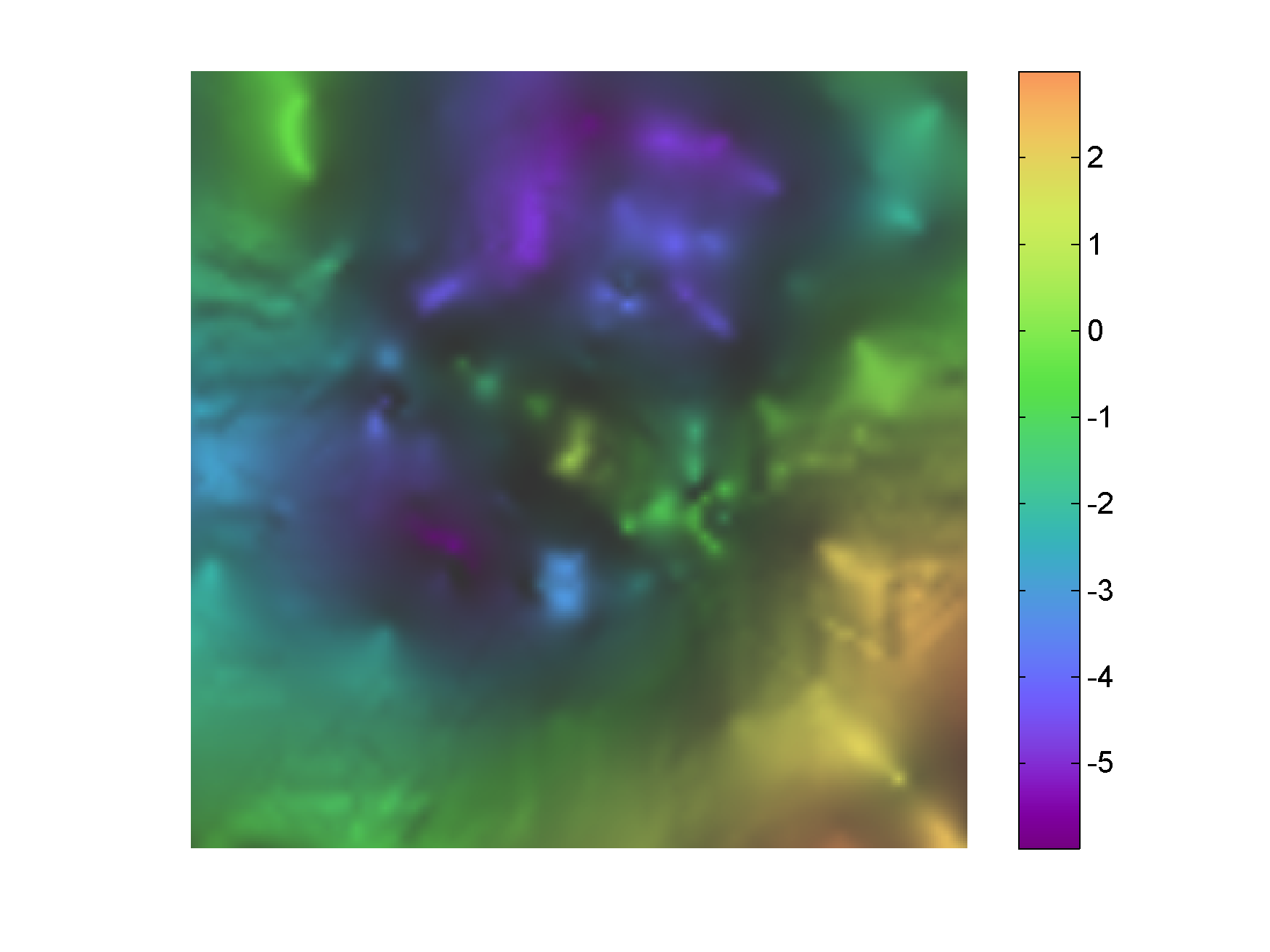
OK, now that we formed a first impression, what can we try to improve on this display? The first thing we can do to increase the perceptual contrast is to add color, as I have done in Figure 2. This is an improvement, now we are able to appreciate smaller changes, quickly assess differences, or conversely identify areas of similar anomaly. Adding the third dimension and perspective is a further improvement, as seen in figure 3. But there’s still something missing. Even though we’ve added color, relief, and perspective, the map looks a bit “flat”.

Figure 2 – Colored residual anomalies in milligals. This version of the map was generate using the IMAGE MAP option in Surfer.
 Figure 3 – Colored 3D residual anomaly map in milligals. This version of the map was generate using the SURFACE MAP option in Surfer.
Adding contours is a good option to further bring out details in the data, and I like the flexibility of contours in Surfer. For example, for Figure 4 I assigned (in Contour Properties, Levels tab) a dashed line style to negative residual contours, and a solid line style to positive residual contours, with a thicker line for the zero contour. This can be done by modifying the style for each level individually, or by creating two separate contours, one for the positive data, one for the negative data, which is handy when several contour levels are present. The one drawback of using contours this way is that it is redundant. We used 3 weapons – color, relief, and contours – to dispaly one dataset, and to characterize just one property, the shape of gravity anomaly. In geoscience it is often necessary, and desireable to show multiple (relevant) datasets in one view, so this is a bit of a waste. I would rather spare the contours, for example, to overlay and compare anomalous concentrations in gold pathfinder elements on this gravity anomaly map (one of the objectives of the study, being the Monti Romani an area of active gold exploration).
 Figure 4 – Colored 3D residual anomaly map in milligals. Contours were added with the the CONTOUR MAP option in Surfer.
  Figure 5 – Colored 3D residual anomaly map in milligals with lighting (3D Surface Properties menu). Illumination is generated by a point source with -135 deg azimuth and 60 deg elevation, plus an additional 80% gray ambient light, a 30% gray diffuse light, and a 10% gray specular light.
The alternative to contours is the use of illumination, or lighting, which I used in Figure 5. Lighting is doing a really good job: now we can recognize there is a high frequency texture in the data and we see some features both in the highs and lows. But there’s a catch: we are now introducing perceptual artifacts, in the form of bright white highlight, which is obscuring some of the details where the surface is orthogonal to the point source light.
There is a way to illuminate the surface without introducing artifact – and that is really wanted to show you with this tutorial – which is to use a derivative of the data to assign the shading intensity (areas of greater gradient were assigned darker shading) [5]. In this case I choose the terrain slope, which is the slope in the direction of steepest gradient at any point in the data (calculated in a running window). The result is a very powerful shading. Here is how you can do it in Surfer:
1) CREATE TERRAIN SLOPE GRID (let’s call this A): go to GRID > CALCULUS > TERRAIN SLOPE
Result is shown in Figure 6 below:

Figure 6 – Terrain slope of residual anomaly. Black for low gradients, white for high gradients. Displayed using IMAGE MAP option.
2) CREATE COMPLEMENT OF TERRAIN SLOPE AND NORMALIZE TO [1 0] RANGE (to assign darker shading to areas of greater slope. This is done with 3 operations:
i) GRID > MATH> B=A – min(A)
where min(A) is the minimum value, which you can read off the grid info (for example you would double click on the map above to open the Map Properties and there’s an info button next to the Input File field) .
ii) GRID > MATH> C=B /max(B)
iii) GRID > MATH> D= 1-C
Result is shown in Figure 7 below. This looks really good, see how now the data seems almost 3D? It would work very well just as it is. However, I do like color, so I added it back in Figure 8. This is done by draping the grayscale terrain slope complement IMAGE MAP as an overlay over the colored residual anomaly SURFACE MAP, and setting the Color Modulation to BLEND in the 3D Surface Properties in the Overlay tab. I really do like this display in Figure 8, I think it is terrific. Let me know if you like it best too.
Finally, in Figure 9, I added a contour of the anomaly in the Gold Pathfiners, to reiterate the point I made above that contours are best spared for a second dataset.
In my next post I will show you how to do all of the above programmatically in Matlab (and share the code). Meanwhile, comments, suggestions, requests are welcome. Have fun mapping and visualizing!
Figure 7 – Complement of the terrain slope. White for low gradients, black for high gradients. Displayed using IMAGE MAP option.
 Figure 8 – Complement of the terrain slope with color added back.
Figure 9 – Complement of the terrain slope with color added back and contour overlay of gold pathfinders in stream sediments.
GOODIES
Did you lie the colormap? In future series on perceptually balanced colormaps I will tell you how I created it. For now, if you’d like to try it on your data you can download it here:
cube1 – generic format with RGB triplets;
Cube1_Surfer – this is preformatted for Surfer with 100 RGB triplets and header line. Dowload the .doc file, open and save as plain text, then change extension to .clr;
Cube1_Surfer_inverse – the ability to flip color palette is not implemented in Surfer (at least not in version 8) so I am including the flipped version of above. Again, dowload the .doc file, open and save as plain text, then change extension to .clr.
RELATED POSTS (MyCarta)
Visualization tips for geoscientists: Matlab
Visualization tips for geoscientists: Matlab, part II
Visualization tips for geoscientists: Matlab, part III
Image Processing Tips for Geoscientists – part 1
Compare lists from text files using Matlab – an application for resource exploration
RELATED CONTENT (External)
Basement structure in central and southern Alberta: insights from gravity and magnetic maps
Making seismic data come alive
Visual Crossplotting
Mapping multiple attributes to three- and four-component color models — A tutorial
Enhancing Fault Visibility Using Bump Mapped Seismic Attributes
ACKNOWLEDGEMENTS
I would like to thank Michele di Filippo at the Department of Earth Science, University of Rome La Sapienza, to whom I owe a great deal. Michele, my first mentor and a friend, taught me everything I know about the planning and implementation of a geophysical field campaign. In the process I also learned from him a great deal about geology, mapping, Surfer, and problem solving. Michele will make a contribution to the gravity exploration series.
NOTES
[1] If you would like to learn more about gravity data interpretation please check these excellent notes by Martin Unsworth Unsworth, Professor of Physics at the Earth and Atmospheric Sciences department, University of Alberta.
[2] Niccoli, M., 2000: Gravity, magnetic, and geologic exploration in the Monti Romani of Southern Tuscany, unpublished field and research thesis, Department of Earth Science, University of Rome La Sapienza.
[3] Moretti A., Meletti C., Ottria G. (1990) – Studio stratigrafico e strutturale dei Monti Romani (GR-VT) – 1: dal Paleozoico all’Orogenesi Alpidica. Boll. Soc. Geol. It., 109, 557-581. In Italian.
[4] Typically reduction of the raw data is necessary before any interpretation can be attempted. The result of this process of reduction is a Bouguer anomaly map, which is conceptually equivalent to what we would measure if we stripped away everything above sea level, therefore observing the distribution of rock densities below a regular surface. It is standard practice to also detrend the Bouguer anomaly to separate the influence of basin or crustal scale effects, from local effects, as either one or the other is often the target of the survey. The result of this procedure is typically called Residuals anomaly and often shows subtler details that were not apparent due to the regional gradients. Reduction to rsiduals makes it easier to qualitatively separate mass excesses from mass deficits. For a more detailed review of gravity exploration method check again the notes in [1] and refer to this article on the CSEG Recorder and reference therein.
[5] Speaking in general, 3D maps without lighting often have a flat appearance, which is why light sources are added. The traditional choice is to use single or multiple directional light sources, but the result is that only linear features orthogonal to those orientations will be highlighted. This is useful when interpreting for lineaments or faults (when present), but not in all circumstances, and requires a lot of experimenting. in other cases, like this one , directional lighting introduces a bright highlight, which obscures some detail. A more generalist, and in my view more effective alternative, is to use information derived from the data itself for the shading. One way to do that is to use a high pass filtered version of the data. i will show you how to do that in matlab in the next tutorial. Another solution, which I favored in this example, is to use a first derivative of the data.